

2025 Community Impact Report
Your inside look at the life-changing power of community.
Residents in communities managed by Cohere report
87%
overall wellbeing compared to just 64% in neighboring communities
92%
feel safe compared to just 77% in neighboring communities
76%
feel they belong compared to just 63% in neighboring communities
What if your neighborhood could make you feel better?
We’re living through what many are calling a loneliness epidemic. More than half of Americans say they feel lonely on a regular basis, social trust is declining, and disconnection has become one of the defining public health challenges of our time.
As the costs of social erosion become clearer, the most visionary land developers and community leaders are rethinking what neighborhoods should deliver. At Cohere, we’re proving that well-run, people-first, master-planned communities are doing more than attracting homebuyers. They’re improving lives.
We believe connection is the foundation of wellness, and that intentionally designed community life can be a powerful intervention.
This report shares what we’ve seen firsthand across the 53 neighborhoods we manage: When people feel a sense of belonging, everything changes. Residents in our communities report higher overall well-being, strong mental health and sense of security, deeper connection within dependable social networks, and more.
Through intentional placemaking, everyday hospitality, and programming rooted in connection and inclusion, Cohere-managed neighborhoods are helping people feel healthier, safer, and more connected to each other and the places they live.
Thrive together,



I could not ask for a better community with better amenities and people. It’s a dream for my family to live here.
Katie A.
Cohere resident
The social vital signs of a neighborhood
We surveyed and compared resident experience in Cohere-managed communities versus non-Cohere communities on 11 core well-being indicators. These wellness pulse points are real markers of how people feel and live in their neighborhoods.
Cohere-managed communities outperformed other neighborhoods in all well-being indicators.
Comparison of high ratings across well-being indicators

Residents in communities managed by Cohere report
86.6%
report high personal well-being
Compared to 64% of residents in other neighborhoods.
73.3%
report high physical health
Compared to 57.5% of residents in other neighborhoods.
Physical health scored 73.3% of Cohere residents versus 57.5% non-Cohere residents — a percentage difference of 15.8%. Access to thoughtfully developed amenities like trails, recreational areas, and health-focused community activities may be driving these improvements.
84.1%
report high mental health
Compared to 63.1% of residents in other neighborhoods.
Mental health received high scores from 84.1% of Cohere residents vs. 63.1% non-Cohere residents, a 21% percentage difference. This second highest observed effect further validates that Cohere’s social fabric and intentional community building contribute to greater emotional and psychological well-being.
92.3%
feel safe in their neighborhood
Compared to 77% of residents in other neighborhoods.
Cohere residents rated this item highly (92.3%), compared to 77% of non-Cohere residents — a percentage difference of 15.3%, which was statistically significant and positive. In partnership with visionary developers, Cohere’s approach to placemaking and community engagement (walkable neighborhoods, familiar neighbors, civic collaboration and informed residents), likely fosters this strong sense of safety.
67.2%
feel socially connected
Compared to 55.9% of residents in other neighborhoods.
With 67.2% of Cohere residents feeling socially connected vs. 55.9% of non-Cohere residents, Cohere neighborhoods foster relationships beyond superficial interactions. These environments cultivate daily contact, small group gatherings, resident-led clubs and communal activities, strengthening interpersonal ties.
75.7%
report "I belong in this neighborhood"
Compared to 62.8% of residents in other neighborhoods.
I belong in this neighborhood.
Belonging scored highly for 75.7% of Cohere residents versus 62.8% in non-Cohere areas — a percentage difference of 12.9%. This difference points to how identity, welcoming, and purpose are cultivated in Cohere-managed neighborhoods with programming like neighbor-to-neighbor warm welcomes, civic and philanthropic engagements.
73.9%
report meaningful friendships
Compared to 59.2% of residents in other neighborhoods.
The friendships and associations I have with other people in my neighborhood mean a lot to me.
73.9% of Cohere residents reported that their neighborhood friendships “mean a lot,” compared to 59.2% among non-Cohere residents — yielding a 14.7% gap. These deep, meaningful relationships appear to be a hallmark of the Cohere experience.
84.4%
believe their neighbors would help them in an emergency
Compared to 69.6% of residents in other neighborhoods.
I believe my neighbors would help me in an emergency.
A large majority of Cohere residents (84.4%) believe their neighbors would help in an emergency, compared to 69.6% of non-Cohere residents — a 14.7% advantage. The high comparative value signals strong community trust and interdependence in Cohere neighborhoods.
62.2%
feel they can get what they need in their neighborhood
Compared to 51.6% of residents in other neighborhoods.
I can get what I need in this neighborhood.
62.2% of Cohere residents feel they can get what they need in their neighborhood vs. 51.6% of non-Cohere residents — a 10.6% difference. This slightest difference observed signals that while access is generally good, there is room to improve.
65.2%
regularly stop and talk with neighbors
Compared to 50.8% of residents in other neighborhoods.
I regularly stop and talk with people in my neighborhood.
65.2% of Cohere residents regularly stop and talk with neighbors, compared to just 50.8% in non-Cohere areas — a 14.4% difference. The behavioral difference is clear: Cohere supports organic, recurring, micro-interactions amongst neighbors.
65.97%
feel connected to their neighborhood
Compared to 53.34% of residents in other neighborhoods.
I feel connected to this neighborhood.
65.97% of Cohere residents feel connected to their neighborhood vs. 53.34% of non-Cohere residents, with a 12.6% percentage difference. This reflects how Cohere fosters a sense of place and belonging through its community life ethos and curated programming.
As a parent of both a high schooler and a middle schooler, I’ve seen firsthand how The Grove Frisco — through its partnership with Cohere — has had a meaningful impact on our family’s well-being. From book clubs and programming groups to community-wide events like Culture Night and resident-led hackathons, these experiences have helped my kids build friendships, gain confidence, and feel a deeper connection to their neighborhood.
Shubha A.
Cohere resident
Community is a powerful source of life satisfaction and life expectancy. It's where we know each other, help each other, and find purpose in contributing to each other's lives.
Dr. Vivek Hallegere Murthy
19th & 21st Surgeon General of the United States
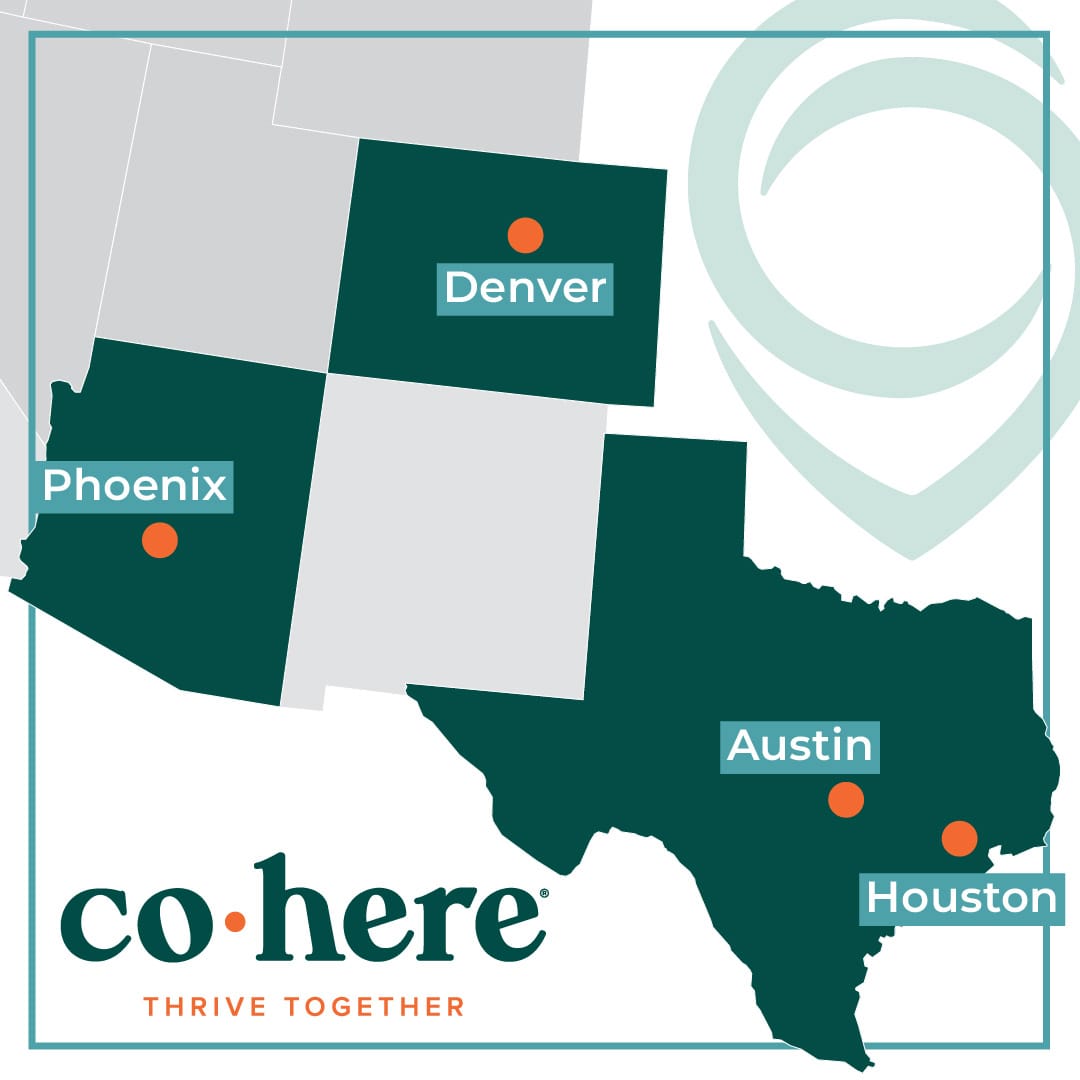
Geographic focus
The survey and comparative analysis was conducted across the greater Houston, greater Austin, greater Phoenix and greater Denver metro areas. The survey included 3,362 individual respondents from Cohere-managed communities and 583 respondents from the same geographic areas living in non-Cohere-managed communities.
The referral power of connected neighborhoods
In real estate, referral behavior isn’t just a sign of resident satisfaction, it’s a sign of organic growth potential. When people recommend where they live, they help raise brand equity and lower customer acquisition costs for builders and developers.
90.7% of Cohere residents say they would recommend their community, and 74.6% already have — a 19-point lead over non-Cohere communities.

Behind the numbers
This report summarizes key findings comparing resident experiences in Cohere-managed communities versus non-Cohere communities. The analysis included 11 core well-being indicators rated on a 1–5 scale, as well as two questions related to neighborhood recommendation behavior.
The survey included 3,362 individual respondents from Cohere-managed communities and 583 respondents from the same geographic areas living in non-Cohere-managed communities.
Overall well-being
Non-Cohere: 64% rated 4 or 5
Δ = 22.7%
Mental health
Non-Cohere: 63.1% rated 4 or 5
Δ = 21%
Physical health
Non-Cohere: 57.5% rated 4 or 5
Δ = 15.8%
Safety & security
Non-Cohere: 77% rated 4 or 5
Δ = 15.3%
Emergency help from neighbors
Non-Cohere: 69.6% rated 4 or 5
Δ = 14.7%
Meaningful friendships
Non-Cohere: 59.2% rated 4 or 5
Δ = 14.7%
Regularly talk to neighbors
Non-Cohere: 50.8% rated 4 or 5
Δ = 14.4%
Belonging
Non-Cohere: 62.8% rated 4 or 5
Δ = 12.9%
Feel connected
Non-Cohere: 53.3% rated 4 or 5
Δ = 12.6%
Social connection
Non-Cohere: 55.9% rated 4 or 5
Δ = 11.3%
Get what I need in this neighborhood
Non-Cohere: 51.6% rated 4 or 5
Δ = 10.5%
Would recommend their neighborhood
Non-Cohere: 84.4%
Δ = 6.3%
Have recommended their neighborhood
Non-Cohere: 55.4%
Δ = 19.2%
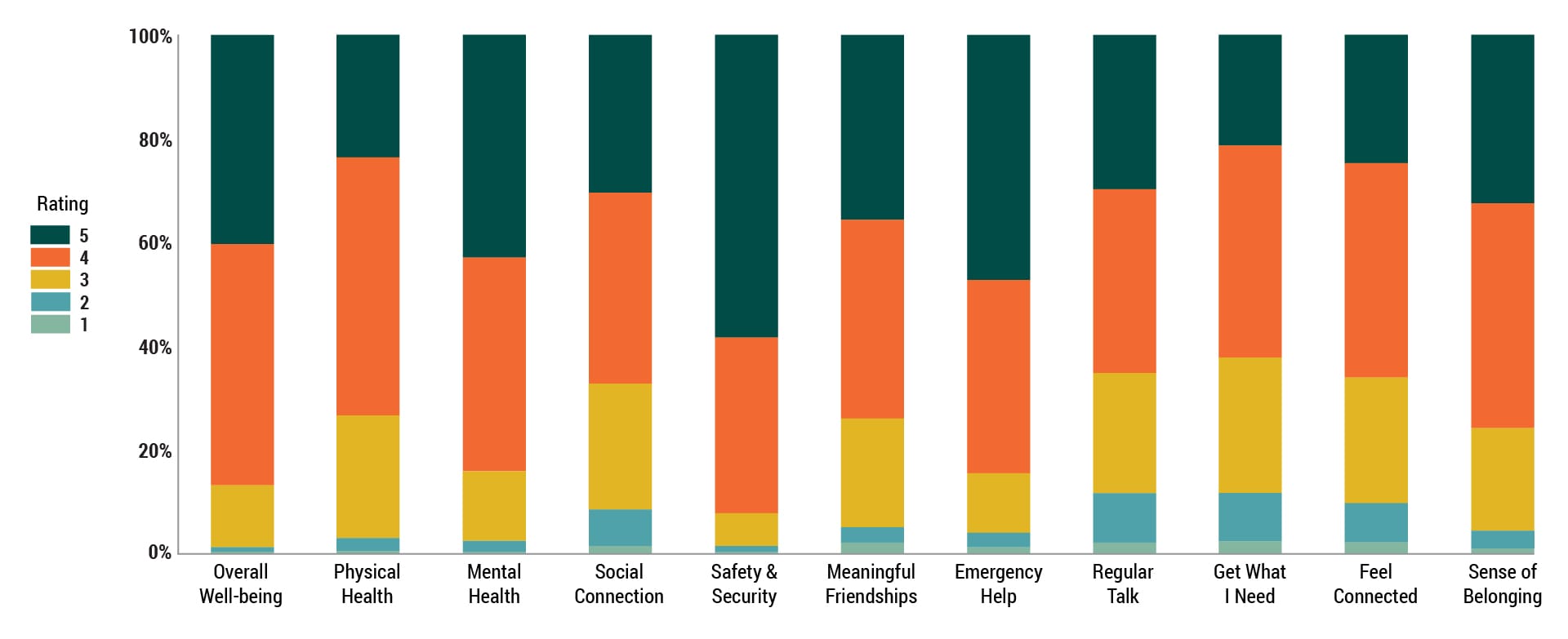
Distribution of Cohere responses
The chart below shows the full distribution (1–5) of resident responses across all 11 indicators in Cohere communities. It helps identify where there are opportunities to shift more residents from a 3 (moderate) into the high-satisfaction range (4–5).
It takes partnership
Cohere creates the conditions for connection by collaborating with visionary developers who invest in life-enhancing amenities like trails, recreational spaces, fitness centers, gathering places and robust community life programming.
Through intentional welcomes, ongoing rhythms of communal gathering, and well-informed, engaged residents, these neighborhoods cultivate stronger social ties, a deeper sense of safety, and a genuine feeling of belonging — core elements that significantly influence overall well-being.
Regional well-being outcomes
Survey responses varied by metropolitan area, revealing distinct patterns in how master-planned community design and management influence resident well-being across different markets.
Greater Houston, Texas
Houston-area residents in Cohere-managed communities reported 22% higher personal well-being and 24.4% stronger mental health compared to nearby neighborhoods.
Greater Austin, Texas
Austin residents showed the strongest outcomes across every core well-being indicator, with 92.6% reporting they feel safe and secure in their neighborhoods.
Greater Phoenix, Arizona
Phoenix-area findings revealed 23.2% higher overall well-being and 21.2% stronger mental health in Cohere-managed communities.
Greater Denver, Colorado
While Denver-area residents participated in the survey, the number of responses did not meet the statistical threshold required for meaningful geographic comparison.






The data and insights presented in this Community Impact Report (CCIR) are provided for informational and illustrative purposes only. While Cohere has made efforts to ensure the accuracy, integrity, and relevance of the data, this report includes a combination of self-reported survey results, resident engagement metrics, and qualitative observations that may be subject to interpretation and limitations.
All findings reflect the conditions, responses, and participation rates specific to the time period and communities in which data was collected. As such, results may not be generalized to other communities or future periods without further validation.
This report is not intended to constitute investment advice, financial projections, or legally binding commitments. Cohere makes no guarantees regarding outcomes based on the use of this report. Stakeholders are encouraged to use these findings in conjunction with other decision-making tools, local context, and professional judgment.
By reviewing this report, the reader acknowledges and accepts these limitations.